Bypassing the Hierarchy
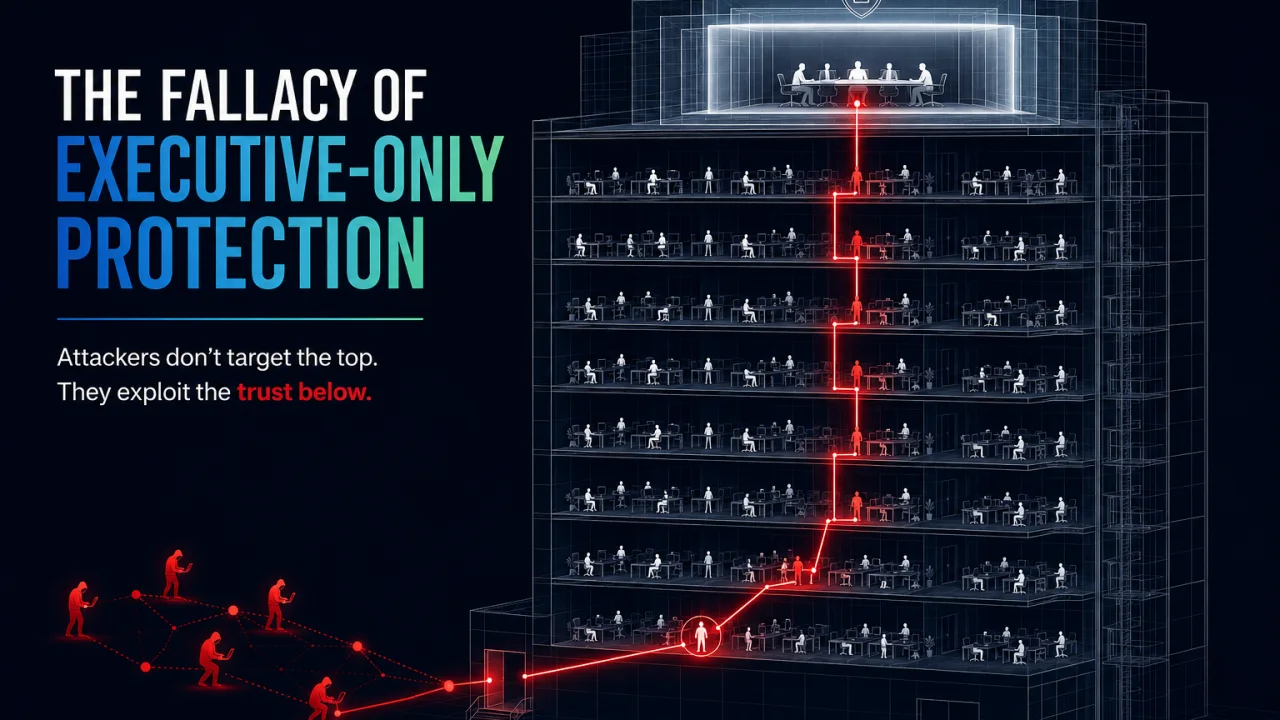
Adversaries do not look at your organizational hierarchy when planning an operation. They look at your network architecture and how permissions are managed. To a sophisticated threat actor, a summer intern or a third-party billing contractor is just as valuable an entry point as the chief executive officer. In fact, they are often preferred targets.
The security industry has spent a decade marketing "Executive Protection" as a premium, concierge-style service designed to shield the digital footprints of the C-suite or our nation's most senior officials. This approach is fundamentally flawed. It treats digital risk as a VIP privilege rather than an organization-wide attack surface. It ignores the operational reality of how modern organizations are breached.
In the field, whether tracing an active breach or reconstructing a sophisticated compromise, the pattern is consistent. Attackers use weaponized open-source intelligence (OSINT) to map the entire organizational structure and locate the path of least resistance. Once they compromise a single internal node, they inherit the organization's internal trust model. We need an immediate shift in strategic framing. We must retire the concept of Executive Protection and replace it with a comprehensive model of Human Capital Protection.
Operational Reality: An attacker does not need to crack the CEO's heavily monitored account if they can simply walk through a junior contractor's unsecured back door and use that legitimate internal access to compromise the network.
The Mechanics of Weaponized OSINT
Every employee, from the front-desk administrator to the senior cloud architect, leaves a digital trail. Threat actors systematically harvest this public debris. They scrape professional networking sites, public code repositories, state business registries, and historical data leaks to map out internal professional relationships, active internal software stacks, and organizational communication patterns.
When an attacker targets an entry-level employee, they are not looking to steal that specific individual's data. They are looking for a beachhead. Once they acquire the active credentials or session cookies of an intern, they log into the organization's environment. To your internal network monitors, this login appears entirely legitimate because it uses valid authentication components.
The adversary is now inside the gates, operating with the trust extended to a valid employee. From this position, they can seamlessly move laterally. They can send an internal message or email to the financial controller or a system administrator. Because the communication originates from a legitimate internal account, standard external email filters are bypassed, and the recipient's psychological defenses drop. A spear-phishing attempt that would fail immediately if sent from an external domain succeeds when it originates from an active internal colleague.
The Flaw of Implied Trust
The root cause of this vulnerability is not a technological failure; it is a design flaw in how modern organizational trust is structured. Most organizations operate on the assumption that once someone is inside the network, they belong there. Once a user passes the perimeter via initial multi-factor authentication, their subsequent actions are assumed to be safe, and their identity is rarely re-verified in context.
When you limit digital risk monitoring and footprint hardening exclusively to executives, you leave the rest of your human architecture entirely exposed. The risk is systemic, meaning the defensive solution must be organization wide. If your governance model treats the identity of a junior administrator as less critical than a vice president, you have misunderstood how attackers calculate utility. Access is currency, and the attacker always looks for the cheapest way to acquire it.
Operating Principles for Human Capital Protection
Transitioning to a Human Capital Protection model requires a disciplined approach to identity and organizational governance. Organizations must operationalize three core defensive principles:
- Map the Entire Workforce Footprint: Expand external risk monitoring and OSINT assessments beyond the executive leadership team. You must continuously identify and remediate the digital exposure of developers, administrative assistants, financial operators, and key third-party vendors who hold network access tokens.
- Eliminate Blind Internal Trust: Stop assuming an account is safe just because it's inside the network. Enforce strict permissions across the board, and never let high-impact requests, like wire transfers or system changes, go through without verifying them through a separate, independent channel. An account should be judged by its behavior, not its position on the chart.
- Harden the Human Verification Layer: Educate the workforce on the precise mechanics of internal lateral movement. Employees must understand that an urgent request coming from a colleague's valid internal account can still be an active malicious operation. Verification must become a hard, non-negotiable business process, not a polite suggestion.
Conclusion
Resilience is not achieved by hardening the top floor while leaving the basement windows unlatched. As long as your digital defense strategy limits human risk management to a handful of executives, you are providing adversaries with an open invitation to exploit the rest of your team.
Security is an interconnected organizational condition, not a localized technical product. If you are not actively protecting your entire workforce surface, you are not managing digital risk; you are simply waiting for an unmonitored identity to be weaponized against you. It is time to protect your human capital with the same operational rigor you apply to your physical and technical infrastructure.
Originally published on LinkedIn.